
Find Buncombe County Property Tax Records
Buncombe County property tax records are managed by the Tax Department in Asheville. The county seat serves as the hub for all property tax administration in western North Carolina. Residents and property owners can search property tax records by account number, property address, or owner name. The Buncombe County tax office provides public access to assessment data, tax bills, and payment history as a public service. With a median property value of $328,900 in 2022, Buncombe County property values sit well above the national average. Searching these records helps owners verify their assessed values and plan for tax payments.
Buncombe County Quick Facts
Buncombe County Tax Department
The Buncombe County Tax Department handles property tax assessment and collection for the entire county. This office determines the value of all real and personal property. Staff members assist residents with questions about property tax records, assessed values, and payment options. The tax office is in downtown Asheville.
All property in Buncombe County is subject to ad valorem taxation under the North Carolina Machinery Act, found in Chapter 105 of the General Statutes. The tax department lists property at its full market value as of January 1 each year. That date serves as the tax lien date for Buncombe County. The North Carolina Department of Revenue supervises local tax programs under G.S. 105-289, and the Buncombe County tax office follows these state guidelines for all property tax records and assessments.
| Office |
Buncombe County Tax Department 94 Coxe Avenue Asheville, NC 28801 |
|---|---|
| Hours | Monday through Friday, 8:00 AM to 5:00 PM |
| Website | tax.buncombenc.gov |
Searching Buncombe County Property Tax Records
You can search Buncombe County property tax records in several ways. The online system lets you look up records from home. Visit the county tax website and enter an account number, street address, or owner name. Results show assessed values, tax amounts, and payment status. The system is free to use.
The Buncombe County Property Record Card system gives even more detail. It shows assessment data along with sales history, building permits, and census information tied to each parcel. This tool is useful for anyone who needs a full picture of a property in Buncombe County. You can view the record card for any parcel without creating an account or paying a fee.
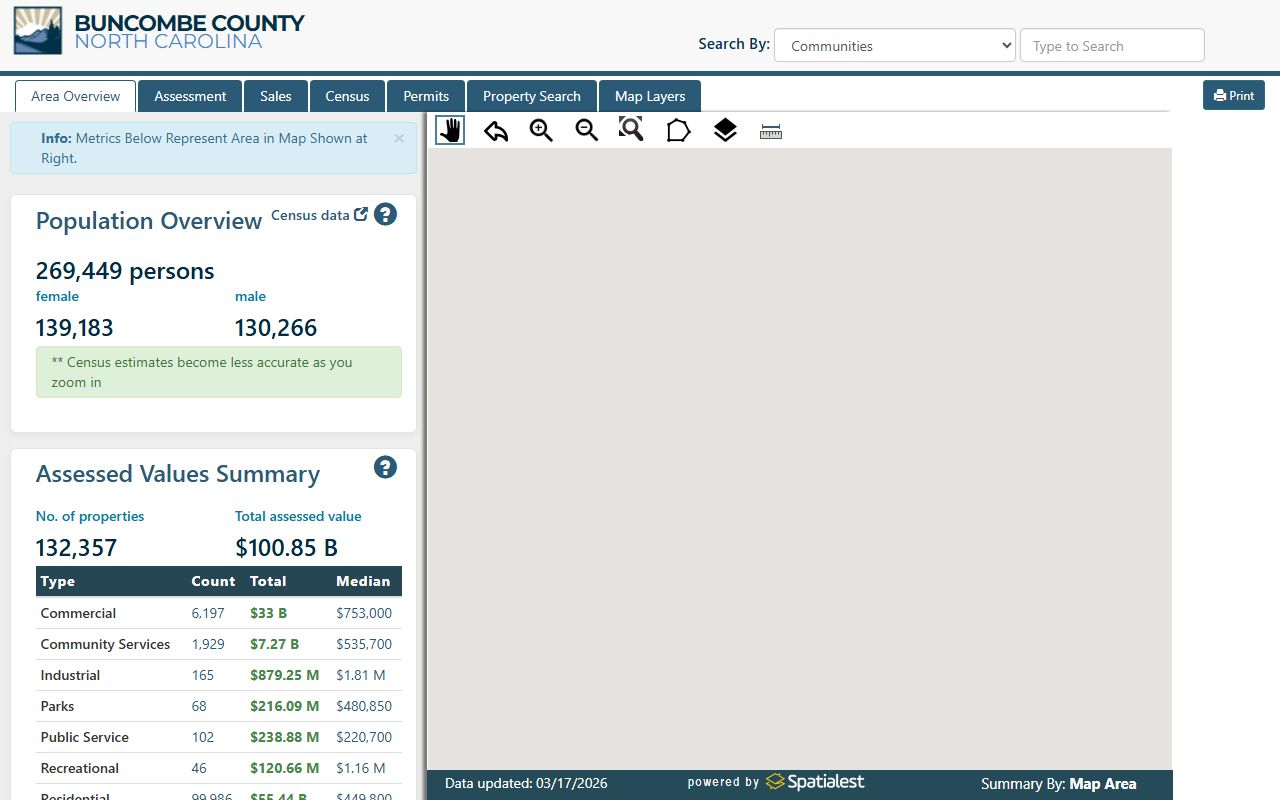
For bulk data and sales reports, the Real Property Data Portal offers sales data and permit information for Buncombe County. This portal is helpful for those who need to compare property values across the county or review recent sales trends.
Note: Property tax records in Buncombe County are public records, and anyone may search them without stating a reason.
Property Tax Values in Buncombe County
Buncombe County saw a 20.1% increase in median property values from 2021 to 2022. That brought the median to $328,900. This figure is 1.17 times the national average. Rising values affect property tax records across the county because assessed values go up.
North Carolina law requires counties to reappraise all property at least every eight years under G.S. 105-286. Buncombe County follows this cycle, and each reappraisal updates the assessed values in property tax records. Between reappraisals, the county adjusts records for new construction, additions, and demolitions. The homeownership rate in Buncombe County stands at 64.4%, meaning most residents have a direct stake in how the county values their property.
The formula for property tax in Buncombe County is straightforward. Take the assessed value, divide by 100, then multiply by the tax rate. For example, a home valued at $328,900 with a rate of $0.529 per $100 would owe about $1,740 in county tax alone. City taxes from Asheville or other municipalities add to that total. Property tax records reflect this calculation for each parcel.
Buncombe County Property Tax Appeals
Property owners in Buncombe County who disagree with their assessed value can appeal. The process starts with an informal review. Contact the tax office and ask to discuss your assessment. Many disputes are resolved at this stage.
If the informal review does not resolve the matter, you can file a formal appeal with the Buncombe County Board of Equalization and Review. This board hears appeals under G.S. 105-322 and has the power to adjust values. You must file your appeal during the board's sitting period, which the county announces each year. Bring evidence such as recent sales of similar properties, an independent appraisal, or photos showing issues with the property.
Beyond the local board, owners may appeal to the North Carolina Property Tax Commission under G.S. 105-288. This state-level body reviews decisions from county boards. Appeals to the Property Tax Commission involve a more formal process. Most property owners resolve their concerns at the county level in Buncombe County.
Note: The deadline to file an appeal with the Board of Equalization and Review varies each year, so check with the Buncombe County tax office for current dates.
Tax Relief Programs in Buncombe County
Buncombe County offers several property tax relief programs for qualifying residents. These programs reduce the tax burden for those who meet specific criteria. All applications go through the Buncombe County tax office.
The Elderly or Disabled Exclusion under G.S. 105-277.1 provides relief to homeowners age 65 or older, or those who are totally and permanently disabled. This program excludes a portion of the home's value from taxation. The Circuit Breaker program under G.S. 105-277.1B caps property tax as a percentage of income for qualifying elderly or disabled owners in Buncombe County. Disabled veterans may receive an exclusion of up to $45,000 from their property's assessed value.
Owners of farm, forest, or horticultural land in Buncombe County may qualify for the Present-Use Value program under G.S. 105-277.2. This program assesses qualifying land based on its current use rather than market value. The deadline to apply for tax relief in Buncombe County is June 1 each year, using Form AV-9. Property tax bills go out in August, come due September 1, and become delinquent on January 6 of the following year.
- Elderly or Disabled Exclusion for homeowners 65 and older
- Circuit Breaker income-based tax limit
- Disabled Veteran exclusion up to $45,000
- Present-Use Value for farms and forests
North Carolina Property Tax Resources
The North Carolina Department of Revenue oversees property tax administration statewide, including Buncombe County. The NCDOR property tax page has forms, guides, and updates that apply to all counties. Property owners in Buncombe County can use these resources to learn about state rules that affect their property tax records.
The General Statutes Chapter 105 contains all the laws that govern property tax in North Carolina. This includes the Machinery Act, which sets the procedures Buncombe County must follow for assessment, collection, and appeals. Understanding these statutes helps property owners know their rights when reviewing their property tax records.
Note: State law changes can affect how Buncombe County handles property tax records, so check the NCDOR site for the latest updates.
Cities in Buncombe County
Buncombe County includes Asheville and several smaller towns. All property tax records for the county are managed through the Buncombe County Tax Department. City taxes are collected separately in some cases.
Municipalities in Buncombe County include Asheville, Black Mountain, Montreat, Weaverville, Woodfin, and Biltmore Forest. Each may have its own tax rate that applies on top of the Buncombe County rate. Property tax records reflect both county and city charges where applicable.
Nearby Counties
These counties border Buncombe County. If your property sits near a county line, confirm which county handles your property tax records. The county where the property is located determines which tax office manages the assessment.