
North Carolina Property Tax Lookup
North Carolina property tax records are maintained by county tax offices across all 100 counties in the state. Each county assessor handles local property appraisals, tax billing, and collections. The North Carolina Department of Revenue oversees the system but does not send tax bills or collect payments directly. You can search property tax records through your county tax office, online portals, or by visiting the assessor in person. These records show assessed values, tax rates, payment status, and ownership details for land and buildings in North Carolina.
North Carolina Property Tax Quick Facts
How North Carolina Property Tax Records Work
Property tax in North Carolina is a local tax. Counties assess and collect it. The state does not bill you or take your payment. Under G.S. 105-289, the Department of Revenue has general oversight of how counties value and tax property. But the day-to-day work falls on county tax assessors and collectors. Each of the 100 counties in North Carolina runs its own tax office with its own staff.
The Machinery Act governs this process. Found in Subchapter II of Chapter 105 of the North Carolina General Statutes, it gives counties the tools to appraise, list, and collect property taxes. All real and personal property in North Carolina must be assessed at 100 percent of its fair market value. The formula is simple. Take the tax value, divide by 100, then multiply by the tax rate. That gives you the tax bill. Tax rates vary from county to county and city to city across North Carolina.
January 1 is the key date for property tax records in North Carolina. It is the tax lien date. Whoever owns the property on that day is responsible for the full year of taxes. The lien attaches on the listing date under Section 105-355(a) and is superior to all other liens per Section 105-356(a). This means property tax claims come first, ahead of mortgages and other debts on the property in North Carolina.
Property Tax Reappraisals in North Carolina
Counties must revalue all property at least once every eight years. G.S. 105-286 sets this rule. Some North Carolina counties choose to reappraise more often. A reappraisal updates the assessed value of every parcel in the county to match current market conditions. This keeps property tax records accurate and fair for all owners in North Carolina.
During a reappraisal year, the county sends new value notices to all property owners. You have the right to review your new assessed value. If you disagree, you can appeal. The reappraisal affects your property tax bill because a higher value means a higher tax, even if the rate stays the same. North Carolina property tax records will show the old value and the new value after each reappraisal cycle.
The NCDOR Property Tax Division monitors county reappraisals to make sure they meet state standards. Counties must follow specific rules on how they appraise land, homes, and commercial buildings. These standards help keep property tax records consistent across North Carolina.
Note: Some counties reappraise every four years instead of eight, so check with your local tax office for the current schedule in North Carolina.
Key Dates for NC Property Tax Records
North Carolina property tax records follow a set annual timeline. The listing period starts in January. Property owners must list taxable personal property during this time. Real estate is listed automatically based on ownership records. Bills go out in late summer, usually in August. Taxes are due on September 1 each year in North Carolina.
If you do not pay by the due date, your taxes become delinquent on January 6 of the following year. After that date, interest starts to build on the unpaid balance. The county can begin enforced collection steps. Tax foreclosure is possible under G.S. 105-374 through an in rem court proceeding. This means the county sues the property itself, not the owner, to recover unpaid taxes in North Carolina.
The NCDOR publishes reports and guides that cover these dates in detail. You can find them on the property tax publications page. These reports also include statewide data on tax rates, collections, and assessed values for property tax records across North Carolina.
The publications page below shows the reports and guides the NCDOR makes available to the public. Visit the NCDOR publications page to download reports on property tax trends and county data.
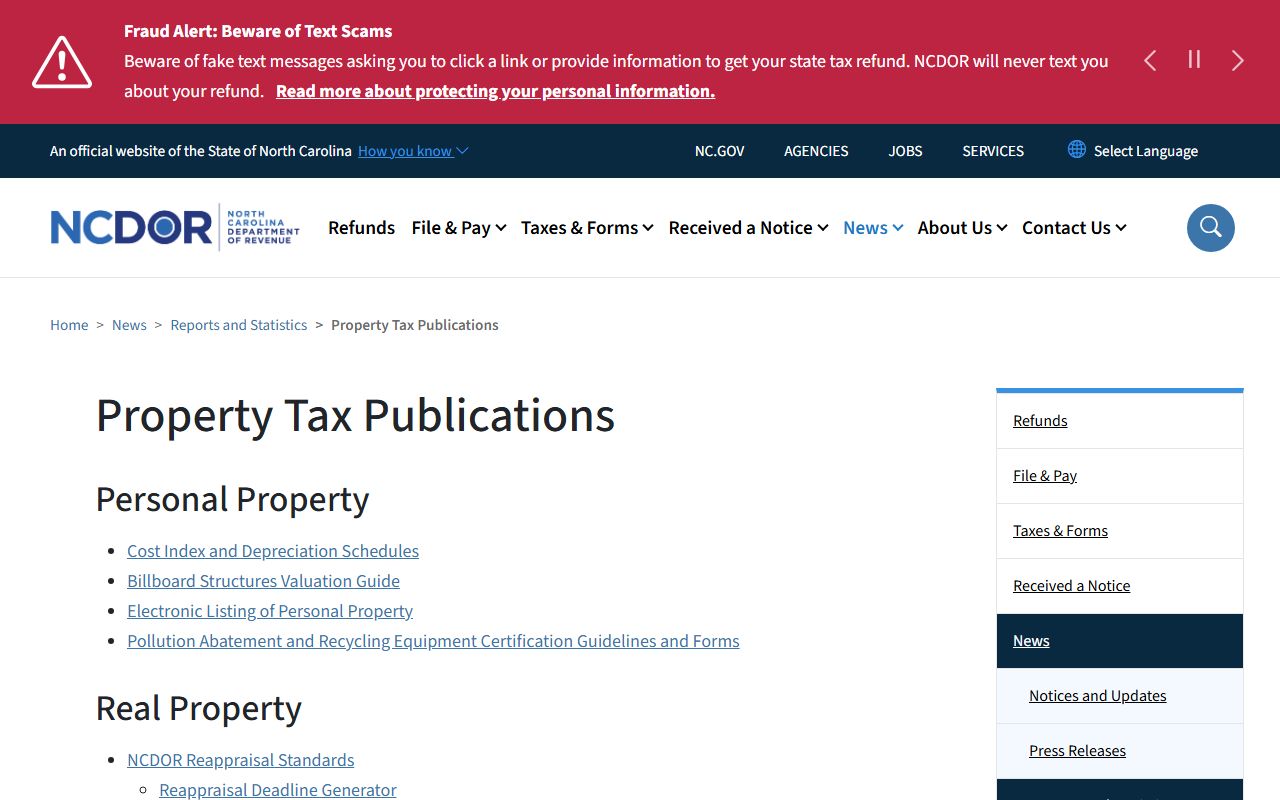
These publications give a clear picture of how property taxes work statewide and help you compare rates between counties in North Carolina.
Appealing North Carolina Property Tax Assessments
If you think your property value is wrong, you have the right to appeal. North Carolina uses a three-stage appeal process for property tax records disputes. Each stage gives you a chance to present your case and ask for a lower assessed value.
The first step is an informal appeal with the county assessor. You contact the tax office and explain why you believe the value is too high. Bring any evidence you have. This might include recent sales of similar homes, an independent appraisal, or photos showing problems with the property. Many disputes in North Carolina get resolved at this stage without going further.
If the informal appeal does not work, the next step is the Board of Equalization and Review. The BER meets each year between the first Monday in April and the first Monday in May, as set by G.S. 105-322. You file a written appeal and attend a hearing. The board reviews your evidence and the county's records. They can raise, lower, or keep the assessed value in your North Carolina property tax records.
The final level is the Property Tax Commission. It has five members appointed by the state. Hearings before the PTC are de novo under G.S. 105-288. That means they start fresh. The commission looks at all the facts again and makes its own decision. PTC decisions are binding and become part of the official property tax records in North Carolina.
NC Property Tax Record Forms
North Carolina uses standard forms for property tax filings, exemptions, and relief programs. The NCDOR maintains these forms and updates them as the law changes. You can download them from the state website or pick them up at your county tax office. Using the right form matters because each one serves a different purpose in the property tax records system.
The NCDOR forms page is the best place to get current versions of all property tax forms. Visit the NCDOR property tax forms page to find the forms you need for your situation.
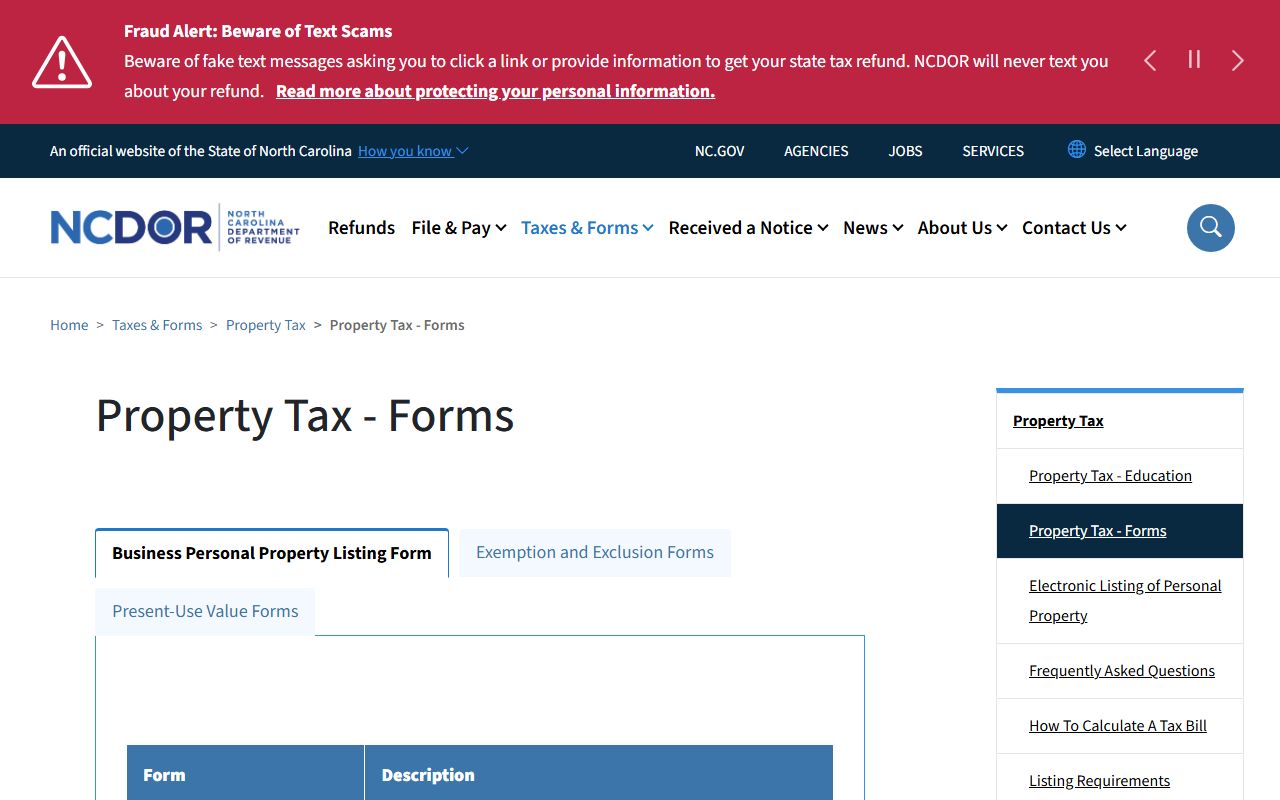
Each form has instructions that explain who qualifies and what documents you need to include with your filing in North Carolina.
Some of the most common forms include:
- AV-9 for property tax relief applications
- AV-10 for exemption or exclusion requests
- AV-5 for the present-use value program
- Business personal property listing forms
- Appeal forms for the Board of Equalization and Review
Note: Always use the most current version of a form, as older versions may not be accepted by the county tax office in North Carolina.
Property Tax Relief Programs in North Carolina
North Carolina offers several programs that reduce the property tax burden for qualifying owners. These programs are part of the state's property tax records system and show up in your tax account as exclusions or deferrals. Each program has its own rules set by the North Carolina General Statutes.
The Elderly or Disabled Exclusion under G.S. 105-277.1 is one of the most used programs. It provides a $25,000 or 50 percent exclusion from the assessed value of a permanent residence. To qualify, you must be 65 or older, or totally and permanently disabled. There are income limits. This exclusion shows in North Carolina property tax records as a reduced taxable value on your home.
The Circuit Breaker program under G.S. 105-277.1B works differently. It caps property taxes at a percentage of your income. If you qualify, the county defers the taxes above that cap rather than forgiving them. The deferred taxes become a lien on the property. They come due when the property is sold or transferred. This program helps elderly and disabled owners stay in their homes in North Carolina.
Disabled veterans get a separate exclusion under North Carolina law. The first $45,000 of assessed value is excluded from taxes. There is no age or income requirement for this benefit. You must have a qualifying disability rating from the Department of Veterans Affairs. The exclusion applies to the veteran's permanent residence and appears in their North Carolina property tax records.
The Present-Use Value Program is for agricultural, horticultural, and forestland. Under G.S. 105-277.2 through 105-277.7, qualifying land is taxed based on its use value rather than market value. A working farm, for example, gets taxed at farm rates, not what a developer might pay. This can mean a big reduction on property tax records for rural landowners in North Carolina.
Related NC Property Tax Records
Property tax records are not the only tax records tied to real estate in North Carolina. The land transfer excise tax applies when property changes hands. Under G.S. 105-228.30(a), the rate is one dollar per five hundred dollars of value. The Register of Deeds collects this tax at the time of recording. It creates a record that shows the sale price and the tax paid. Recording fees are set by G.S. 161-10 in North Carolina.
The Tax and Tag Together program is another record worth knowing about. Since 2013, North Carolina has combined vehicle registration renewal with personal property tax on motor vehicles. When you renew your tags through the NC DMV, you also pay the property tax on your car at the same time. This creates a combined tax record that links your vehicle property tax to your registration in North Carolina.
The DMV page below shows where you can manage your vehicle registration and property tax payments together. Visit the NC DMV Tax and Tag page for details on paying vehicle property taxes.
This combined system makes it easier for vehicle owners to stay current on both their registration and their property taxes in North Carolina.
NC County Property Tax Record Offices
Your county tax assessor is the main point of contact for property tax records. They handle appraisals, maintain the tax rolls, and process exemptions. Each of the 100 counties in North Carolina has its own assessor office. Some counties call it the tax administration office or the tax department. The role is the same.
The NCDOR keeps a complete list of all county assessors in North Carolina. This directory includes names, phone numbers, and mailing addresses. If you need to look up property tax records, file a listing form, or ask about an exemption, your county assessor is where to start. You can also reach the NCDOR Property Tax Division at P.O. Box 871, Raleigh, NC 27602, or call 919-814-1129 for general questions about property tax in North Carolina.
NC Public Property Tax Records Access
Yes. Property tax records are public in North Carolina. Anyone can look up the assessed value, tax amount, and payment status for any parcel. Most counties offer online search tools where you can look up records by owner name, address, or parcel number. You do not need to be the owner to view these records.
County GIS systems often work alongside property tax records in North Carolina. They let you view parcel maps, zoning data, and assessed values on a single screen. Many counties link their GIS maps directly to the tax records database. This makes it easy to find a property and see its full tax history. The NCDOR forms page also has guides on how to request records if the county does not offer online access.
Note: While tax records are public, some personal details like Social Security numbers are redacted from public copies in North Carolina.
Browse NC Property Tax Records by County
Each county in North Carolina has its own tax office that maintains property tax records. Pick a county below to find local assessor contact info and resources for tax records in that area.
NC City Property Tax Records
Residents of major cities pay property taxes through their county tax office. Pick a city below to learn about property tax records in that area.