
Find Raleigh Property Tax Records
Raleigh property tax records are maintained by the Wake County Tax Administration office. As North Carolina's capital city, Raleigh has a large and growing tax base. You can search Raleigh property tax records online through the Wake County tax portal. The portal shows assessed values, tax amounts, and payment status for every parcel. Whether you own a home or are researching a property, Raleigh property tax records are open to the public and easy to access.
Raleigh Property Tax Quick Facts
Raleigh Property Tax Office
Wake County Tax Administration manages all property tax records for Raleigh. The office is at 301 S. McDowell Street, Suite 3800, Raleigh, NC 27601. You can call 919-856-5400 with questions about your Raleigh property tax records. The office is open Monday through Friday during normal business hours.
| Office | Wake County Tax Administration |
|---|---|
| Address | 301 S McDowell St, Suite 3800 Raleigh, NC 27601 |
| Phone | 919-856-5400 |
| Online Portal | Wake County Tax Portal |
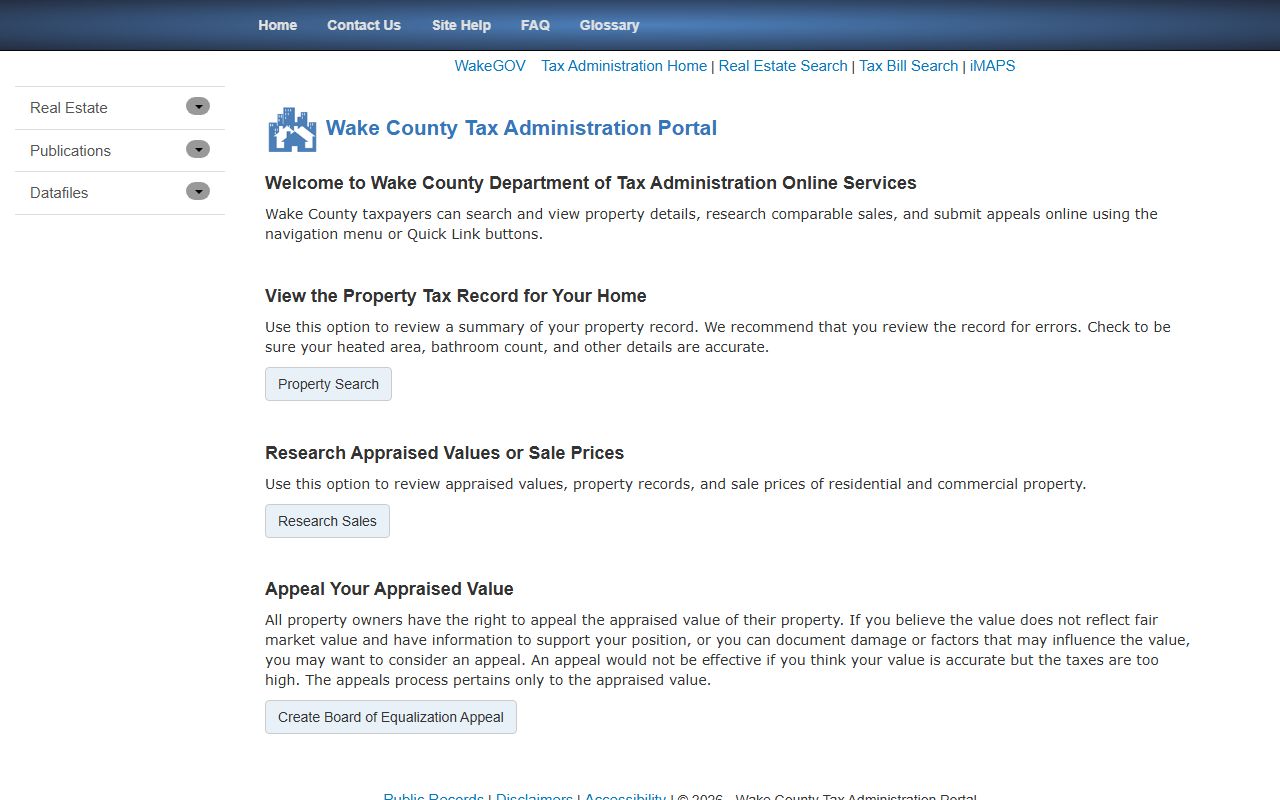
The Wake County Tax Administration website has forms, FAQs, and links to look up property tax records in Raleigh. You can also search real estate data at the county's real estate portal for detailed parcel information.
How Raleigh Property Taxes Work
All real property in Raleigh is assessed at 100% of fair market value as of January 1. The tax lien attaches on that date under North Carolina law. Wake County handles the assessment for every parcel in Raleigh. The county follows G.S. 105-289, which requires local assessment of all property.
To figure your tax, take the assessed value, divide by 100, and multiply by the rate. Raleigh's rate is 61.95 cents per $100 of assessed value. The city's budget tops $1.7 billion, funded in large part by property tax revenue. Your bill also includes the Wake County rate and any special district charges. All of these show up in your Raleigh property tax records.
Reappraisals happen on an eight-year cycle under G.S. 105-286, though Wake County has done them more often. Assessment notices go out by mid-April each year. The notice shows your market value, assessed value, and an estimated tax bill. Review it closely. If the numbers look wrong, that is the time to act.
Search Raleigh Property Tax Records Online
The Wake County Tax Portal is the main tool for finding Raleigh property tax records. You can search by owner name, address, or parcel number. Results show the assessed value, tax rate, amount billed, and payment history. The portal is free to use and open around the clock.
You can also search Wake County real estate records for deed and ownership details. That site is at services.wakegov.com/realestate. It covers all properties in Raleigh and the rest of Wake County. Each listing ties back to the tax record so you can see both property details and tax data in one search.
For in-person help, visit the tax office on McDowell Street. Staff can pull up Raleigh property tax records and print copies. Bring the property address or parcel ID to speed things up.
Raleigh Tax Bills and Payments
Tax bills in Raleigh go out in August. They are due September 1. You must pay by January 5 to avoid late charges. After that date, the bill becomes delinquent and penalties start to add up. Always check your Raleigh property tax records in the fall to make sure your payment went through.
You can pay online through the Wake County Tax Portal. The site accepts electronic checks and credit or debit cards. You can also pay by mail or in person at the tax office. Phone payments may be available as well. Check the portal for current options.
Note: If your mortgage company pays your taxes through escrow, verify with your lender that the payment was made on time. Escrow errors can lead to late fees on your Raleigh property tax records.
Raleigh Property Tax Rates by Area
Effective tax rates in Raleigh range from about 0.87% to 1.10% depending on your zip code. The difference comes from overlapping tax districts. Some areas pay fire district fees or other special assessments on top of the base city and county rates.
The highest average bill in Raleigh is in the 27608 zip code, at about $6,670 per year. The lowest is in 27610, at roughly $2,024. These figures reflect both higher home values and rate differences across the city. Your Raleigh property tax records will show the exact breakdown for your parcel.
Appealing Your Raleigh Assessment
If you believe your Raleigh property is assessed too high, you can appeal. Start with an informal review by the Wake County Assessor. Bring comparable sales data or other evidence that supports a lower value. Many disputes get settled at this step.
If the informal route does not work, file with the Board of Equalization and Review under G.S. 105-322. This board holds hearings and can adjust your value. Beyond that, you can appeal to the North Carolina Property Tax Commission (G.S. 105-288). Each level has deadlines, so act fast once you get your notice. All appeal outcomes become part of your Raleigh property tax records.
Raleigh Tax Relief Programs
North Carolina offers several programs that can lower your Raleigh property tax bill.
- Elderly or Disabled Exclusion (G.S. 105-277.1): Excludes part of your home's value if you are 65 or older or totally disabled.
- Circuit Breaker (G.S. 105-277.1B): Caps tax based on income for qualifying Raleigh homeowners.
- Disabled Veteran Exclusion: Up to $45,000 off assessed value for 100% disabled veterans.
- Present-Use Value (G.S. 105-277.2): Agricultural, forest, or horticultural land taxed at use value, not market value.
Applications are due by June 1 each year on form AV-9. Contact Wake County Tax Administration to learn which relief programs apply to your Raleigh property tax records. You must reapply annually to keep your benefits active.
Wake County Property Tax Records
Raleigh is the county seat of Wake County. All property tax assessment and collection goes through the county tax office. Wake County manages records for Raleigh and every other municipality in the area. For more on county tax rates, relief programs, and related records, visit the Wake County property tax records page.