
Wake County Tax Bill and Assessment Lookup
Wake County property tax records are managed by the Tax Administration department in Raleigh. Wake County is the most populous county in North Carolina with over 1.1 million residents. The tax office handles assessment, listing, and collection for all real and personal property. Property owners can search tax bills, view assessed values, and make payments through the county's online portal. The county seat is Raleigh, and the tax office at 301 S McDowell Street serves the entire county. Wake County borders Durham, Franklin, Johnston, Harnett, Chatham, and Granville counties.
Wake County Quick Facts
Wake County Tax Administration
The Wake County Tax Administration office manages all property tax records for the county. This department lists real property, personal property, and registered motor vehicles. It also handles billing and collection. The office is at 301 S McDowell Street, Suite 3800, in Raleigh.
Wake County assesses property at 100% of fair market value as required by G.S. 105-289. The current tax rate is 61.95 cents per $100 of assessed value. The average assessed value in Wake County is about $337,000. The county's annual budget exceeds $1.7 billion, and roughly 52% of that funds Wake County Public School System operations. Tax bills are mailed in August and payment is due by September 1. Taxes become delinquent on January 6 of the following year.

| Office |
Wake County Tax Administration 301 S McDowell St, Suite 3800 Raleigh, NC 27601 Phone: (919) 856-5400 |
|---|---|
| Hours | Monday through Friday, 8:30 AM to 5:15 PM |
| Website | wakegov.com/departments-government/tax-administration |
Search Wake County Property Tax Records Online
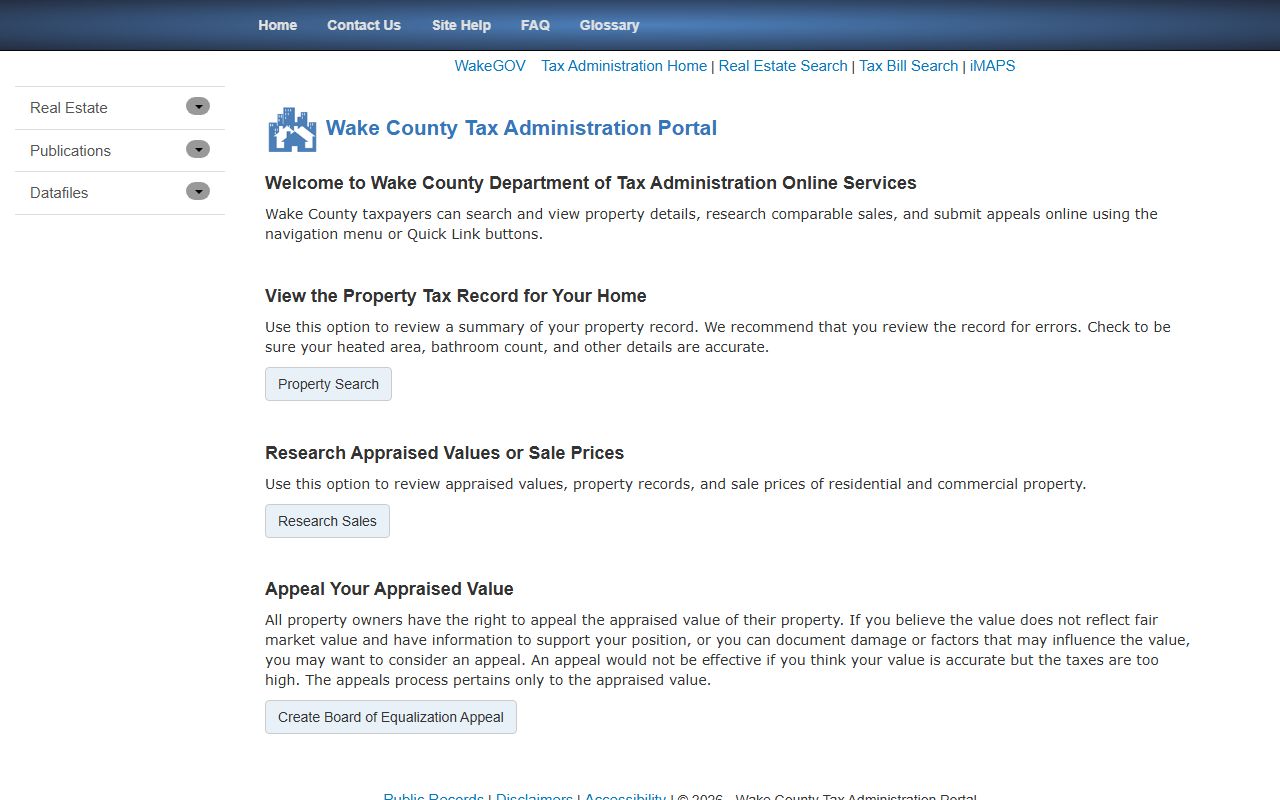
Wake County offers two main online tools for property tax research. The Tax Portal lets you search tax bills and make payments. The Real Estate system shows property details, assessed values, and ownership history. Both tools are free and open to the public.
To use the Wake County Tax Portal, enter the owner name, property address, or bill number. Results show the current tax bill, payment status, and any past due amounts. You can pay online with a credit card or electronic check. The portal covers both real property and personal property tax bills in Wake County.
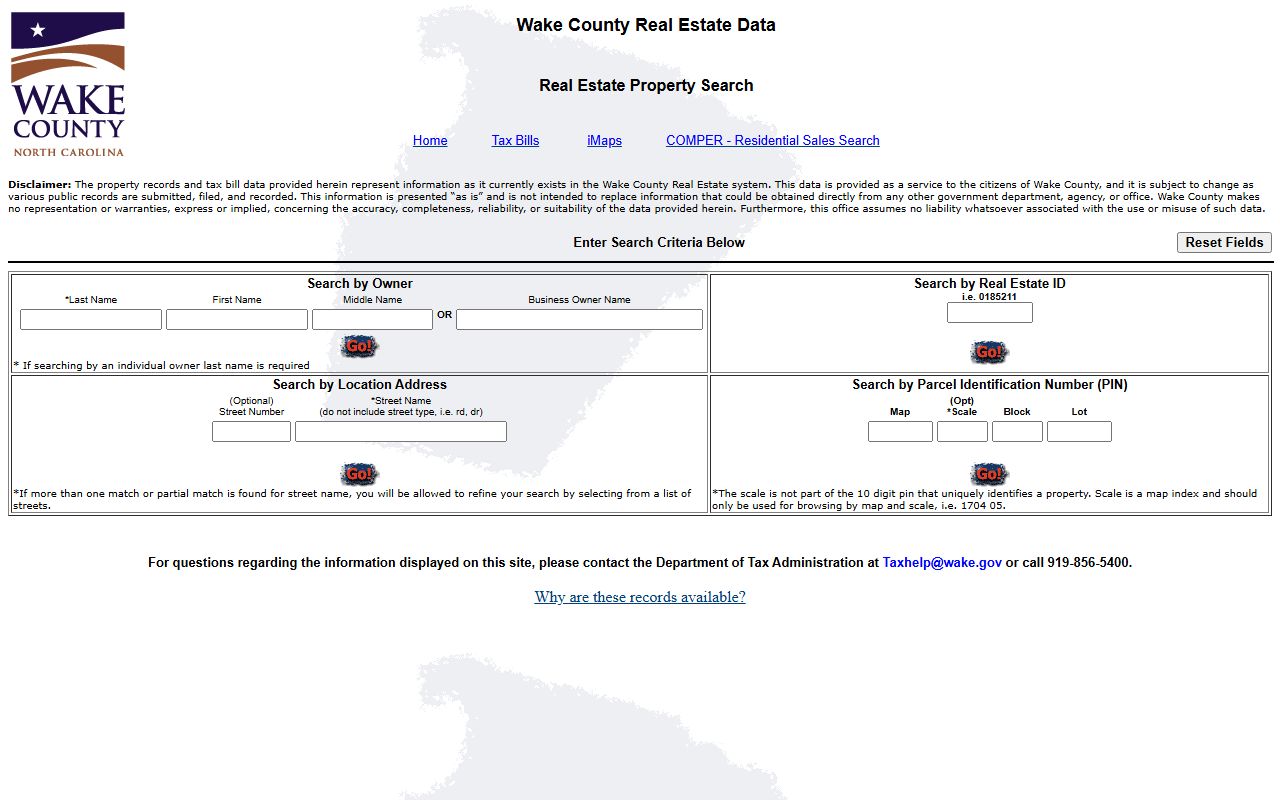
The Wake County Real Estate lookup provides detailed property data. Search by address, owner name, or parcel ID. Each record shows the assessed value, lot size, building details, and sales history. This tool is useful for comparing values and checking property characteristics across the county.
Wake County Property Tax Rates
The Wake County tax rate is 61.95 cents per $100 of assessed value. Municipal rates are added on top of the county rate. Residents of Raleigh, Cary, Apex, and other towns pay both county and city taxes. The combined effective rate ranges from about 0.87% to 1.10% depending on your zip code.
Tax bills in Wake County vary widely by area. The highest median tax bill is in zip code 27608, where homeowners pay around $6,670 per year. The lowest median bill is in zip code 27610 at about $2,024 per year. The median home value in Raleigh is approximately $274,892. These differences reflect both property values and the combined tax rates that apply in each location. Your tax bill is calculated by taking the assessed value, dividing by 100, and multiplying by the total applicable rate.
Note: Special district taxes for fire, transit, or other services may also apply to your property in Wake County. Check your tax bill for all line items.
Wake County Tax Assessments
Wake County reappraises all real property on a regular cycle. State law under G.S. 105-286 requires reappraisal at least every eight years. Wake County typically reappraises more often than the minimum. During reappraisal, assessors review sales data, inspect properties, and set new values based on current market conditions.
Assessment notices are mailed in mid-April each year during a reappraisal. These notices show the old value and the new value for your property. Property owners who disagree with the new value can appeal. The informal appeal starts with the Tax Administration office. If that does not resolve the issue, you can go before the Wake County Board of Equalization and Review under G.S. 105-322. A final appeal option is the North Carolina Property Tax Commission under G.S. 105-288.
Property owners must report improvements to the Tax Administration office. New construction, additions, and major renovations affect your assessed value. The county tracks building permits and adjusts values as needed throughout the year.
Property Tax Relief Programs
Several tax relief programs are available to qualifying Wake County residents. The Homestead Exclusion under G.S. 105-277.1 benefits homeowners age 65 or older and those who are totally and permanently disabled. It excludes the greater of $25,000 or 50% of the assessed value from taxation.
The Circuit Breaker program under G.S. 105-277.1B limits tax based on income for eligible seniors and disabled owners. Disabled veterans can receive an additional $45,000 exclusion from their property value. The Present-Use Value program under G.S. 105-277.2 provides reduced assessments for qualifying farm, forest, and horticultural land. Applications must be submitted to the Wake County Tax Administration office by June 1 each year on the AV-9 form.
Wake County Property Listing
All personal property must be listed with Wake County during January each year. Items include boats, aircraft, unlicensed vehicles, and business equipment. Real property and registered motor vehicles are listed automatically. Failure to list on time results in a 10% late listing penalty on the tax due.
The North Carolina Department of Revenue sets statewide guidelines for property listing and assessment. Wake County follows these rules while applying its own local tax rate. The General Statutes Chapter 105 contains the full legal framework that governs property taxation in North Carolina and Wake County.
Cities in Wake County
Wake County has many municipalities. Residents in each city pay both county and city property taxes. The county tax office handles the county portion from one location in Raleigh.
Nearby Counties
These counties border Wake County. Property near a county line is taxed by the county where the parcel is located. Check your deed or the GIS map to confirm.