
Search Chatham County Property Tax Records
Chatham County property tax records are maintained by the Tax Office in Pittsboro, the county seat. Located between the Triangle area and the Piedmont Triad, Chatham County has seen steady growth in recent years. Property owners can search for assessed values, tax bills, and payment history through the county's online property search tool or by visiting the tax office. The county uses the Spatialest platform for property data access. Searching your Chatham County property tax records helps you confirm your assessed value and understand your annual tax obligation.
Chatham County Quick Facts
Chatham County Tax Office
The Chatham County Tax Office is responsible for assessing property values and collecting property taxes across the county. This office maintains all Chatham County property tax records. Staff can help you understand your assessment, review your tax bill, and connect you with the right forms.
North Carolina law requires Chatham County to assess all taxable property at 100% of fair market value as of January 1 each year. The Machinery Act in Chapter 105 of the General Statutes governs this process. The North Carolina Department of Revenue supervises local tax programs under G.S. 105-289, and Chatham County follows these state requirements. The tax office is located in the Chatham County Government Complex in Pittsboro.
| Office |
Chatham County Tax Office 12 East Street Pittsboro, NC 27312 |
|---|---|
| Hours | Monday through Friday, 8:00 AM to 5:00 PM |
Searching Chatham County Tax Records Online
Chatham County offers online access to property tax records through the Spatialest property search platform. This tool lets you look up any parcel in the county by owner name, address, or parcel ID. Results show assessed values, property details, and mapping information.
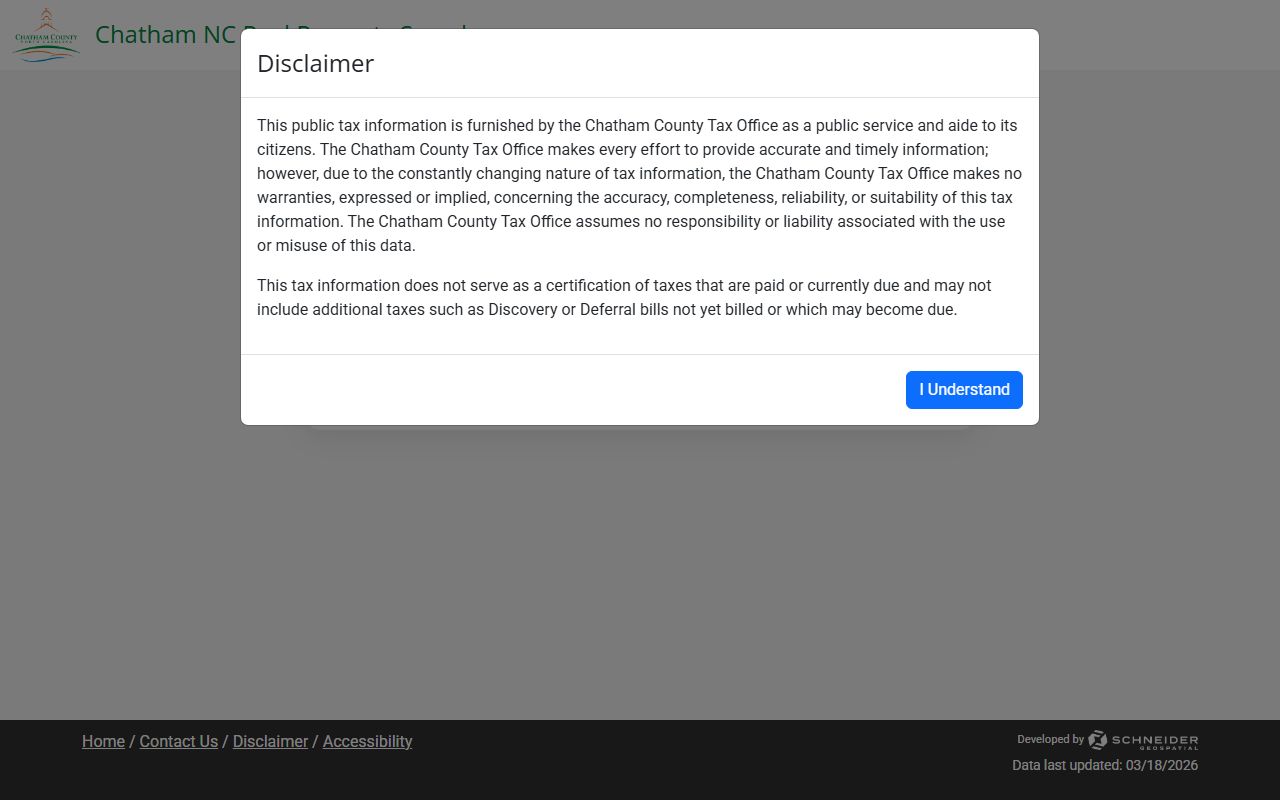
The online system is free and available to anyone. You do not need to create an account. Search results display the current assessed value, land and building details, and tax information. The mapping feature shows parcel boundaries and neighboring properties. This platform makes it easy to research Chatham County property tax records from anywhere.
For information not available online, visit the Chatham County Tax Office in Pittsboro. Staff can provide printed property cards, detailed tax histories, and help with questions about your assessment. Property tax records in Chatham County are public, so anyone can request them.
Note: The online search tool may not reflect the most recent property transfers or payments, so verify with the Chatham County tax office for the latest data.
Property Tax Values in Chatham County
Chatham County has experienced significant growth. New development around Pittsboro and the northern part of the county has brought more residents and higher property values. This growth affects property tax records as the tax office adjusts values to reflect the changing market.
North Carolina requires reappraisal at least every eight years under G.S. 105-286. Chatham County follows this schedule. During a reappraisal year, the county reviews all parcels and assigns updated values based on current market data. Between reappraisals, the tax office updates property tax records for new construction, additions, and demolitions. Sales data from recent transactions helps the county track market trends and verify that assessments are accurate.
The property tax formula in Chatham County is straightforward. Divide your assessed value by 100 and multiply by the tax rate. If your property is inside a town like Pittsboro, Siler City, or Goldston, you pay municipal tax in addition to the county rate. Property tax records show all applicable rates and the total amount due for each parcel.
Chatham County Property Tax Appeals
Property owners who disagree with their assessed value can appeal in Chatham County. Start with an informal discussion at the tax office. Bring evidence such as recent sales of comparable properties, an independent appraisal, or documentation of property issues that affect value.
If the informal review does not resolve the matter, file a formal appeal with the Chatham County Board of Equalization and Review under G.S. 105-322. This board meets each year during a designated period. They hear from both the property owner and the tax office. The board can adjust the assessed value based on the evidence. Beyond the local board, owners may appeal to the North Carolina Property Tax Commission under G.S. 105-288 for further review of their Chatham County property tax records.
Most disputes in Chatham County are resolved at the informal stage. The tax office staff work with owners to address concerns and correct errors when supported by evidence.
Tax Relief in Chatham County
Chatham County offers property tax relief programs for qualifying residents. The Elderly or Disabled Exclusion under G.S. 105-277.1 reduces the taxable value for homeowners 65 and older or those with total and permanent disability. The Circuit Breaker program under G.S. 105-277.1B caps property tax as a share of the owner's income.
Disabled veterans in Chatham County can exclude up to $45,000 from their assessed value. The Present-Use Value program under G.S. 105-277.2 is widely used in Chatham County, where many landowners maintain farms, forests, and horticultural operations. This program assesses qualifying land at its current use value rather than market value, which often results in a significant reduction in the property tax records.
- Elderly or Disabled Exclusion for qualifying homeowners
- Circuit Breaker income-based tax limit
- Disabled Veteran exclusion up to $45,000
- Present-Use Value for agricultural and forest land
- Applications due June 1 on Form AV-9
Note: Growth in Chatham County means land enrolled in Present-Use Value may face deferred taxes if the land use changes or the property is sold for development.
Paying Chatham County Property Tax
Chatham County sends tax bills in August each year. Payment is due by September 1. Taxes become delinquent on January 6 of the following year. Interest begins to accrue on unpaid balances after the delinquent date.
The owner on record as of January 1 is responsible for the full year of property tax. You can pay at the Chatham County tax office in Pittsboro, by mail, or through any online options the county provides. If property changes hands during the year, the tax is usually prorated between buyer and seller at closing. However, the county sends the bill to the owner of record on the lien date. Your payment history is part of the public property tax records kept by Chatham County.
North Carolina Tax Guidance
The North Carolina Department of Revenue oversees property tax across the state. Their website has forms, publications, and legal references that apply to Chatham County and all North Carolina counties.
The General Statutes Chapter 105 contains the Machinery Act and all other property tax statutes. These laws set the rules Chatham County follows for listing property, assessing values, collecting taxes, and hearing appeals. Understanding these statutes helps owners review their Chatham County property tax records with confidence.
Cities in Chatham County
Chatham County includes the towns of Pittsboro, Siler City, Goldston, and Bear Creek. Parts of Cary and Apex also extend into Chatham County. All property tax records within the county are managed by the Chatham County Tax Office. Municipal tax rates vary by town and are applied on top of the county rate.
Nearby Counties
These counties border Chatham County. Confirm which county your property is in before contacting the tax office. Property tax records are managed by the county where the land is located.