
Guilford County Property Tax Lookup
Guilford County property tax records are managed by the Guilford County Tax Department, which operates through both Assessor and Collector offices. The department lists, appraises, and assesses all taxable property within Guilford County. Searching for property tax records can be done online or at either office location. The Greensboro office is at 400 W Market Street and the High Point office is at 325 E Russell Avenue. Both offices are open Monday through Friday from 8 AM to 5 PM. Guilford County is one of the largest counties in North Carolina, with roughly 229,980 property tax notices mailed each year.
Guilford County Quick Facts
Guilford County Tax Department
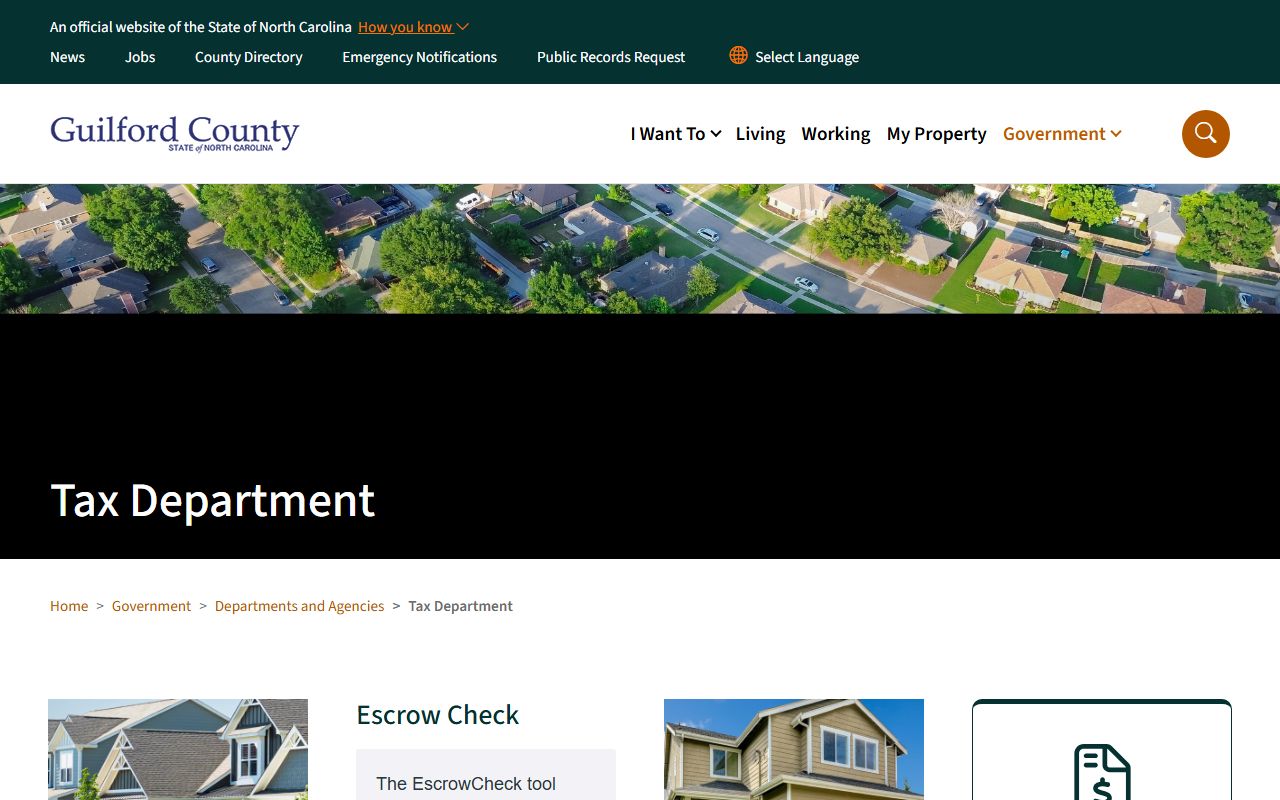
The Guilford County Tax Department is responsible for all property tax records in the county. Tax Director Ben Chavis leads the department. The Assessor side handles listing, appraising, and assessing all taxable property. The Collector side handles billing and collecting taxes for the county and its municipalities. These include Greensboro, High Point, Jamestown, Oak Ridge, Pleasant Garden, Sedalia, Summerfield, Whitsett, Gibsonville, and parts of Archdale, Burlington, and Kernersville.
All real and personal property in Guilford County is assessed at 100% of fair market value as required by North Carolina law. The county follows a five-year revaluation cycle. The last revaluation was in 2022. The next one is set for 2026. Between revaluations, the Guilford County Tax Department may adjust values for new construction, additions, or other changes to the property. The tax rate for FY2025-2026 is 73.05 cents per $100 of assessed value. Your tax bill equals the assessed value divided by 100, then multiplied by the tax rate.
| Office |
Guilford County Tax Department 400 W Market St Greensboro, NC Phone: (336) 641-3363 |
|---|---|
| Hours | Monday through Friday, 8:00 AM to 5:00 PM |
| taxdir@guilfordcountync.gov |
How to Search Property Tax Records
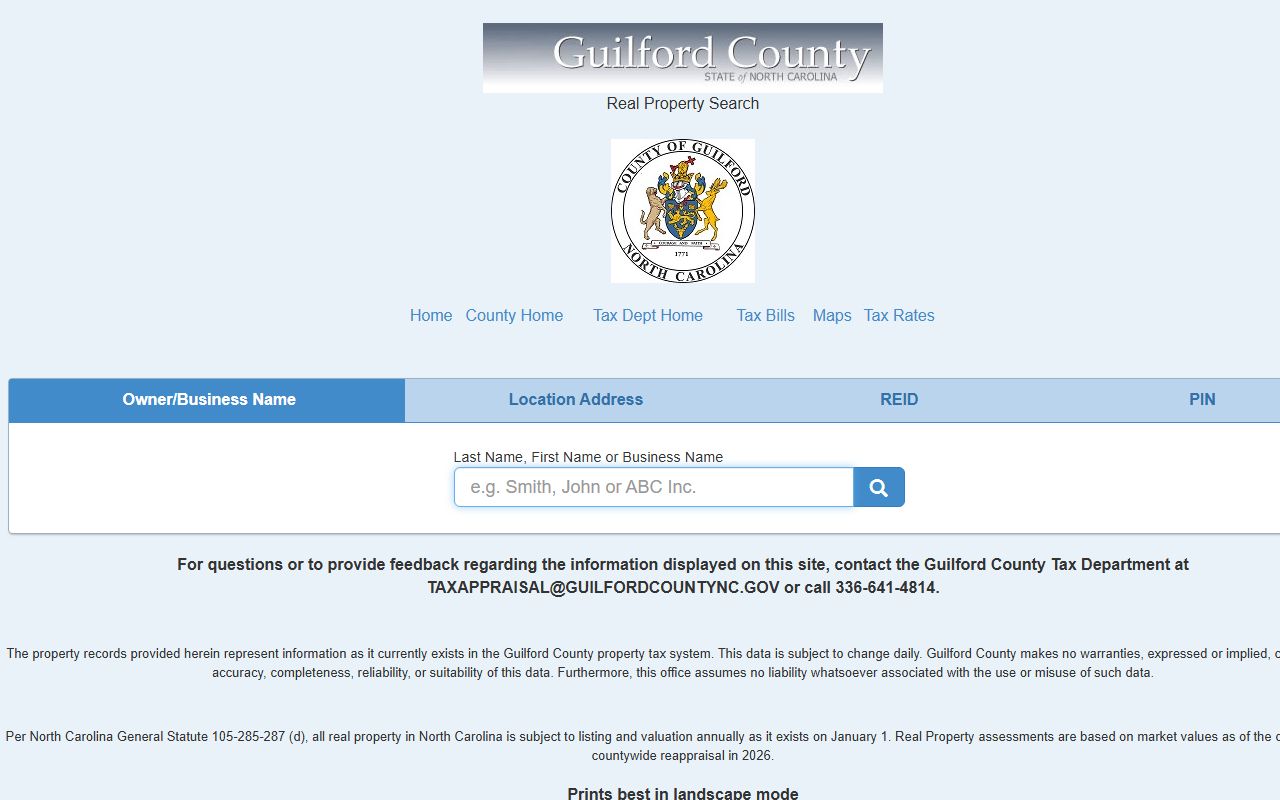
Guilford County offers an online property search tool at lrcpwa.ncptscloud.com/guilford. This tool lets you look up property tax records by owner name, address, or parcel number. Results show assessed values, tax amounts, and property details. The system is free to use.
The county also has a GIS Data Viewer for mapping and parcel data. This can help you locate a property and see its boundaries, zoning, and surrounding parcels. For deed records, the Guilford County Register of Deeds is at 201 S Eugene Street in Greensboro and can be reached at (336) 641-7556. The Register of Deeds maintains ownership history, liens, and other recorded documents tied to Guilford County property tax records.
To search in person, visit either the Greensboro or High Point tax office. Bring a property address or parcel ID. Staff can pull up records and print copies. You can also call (336) 641-3363 for help with your search.
Guilford County Tax Payments
Property tax bills in Guilford County are mailed in late summer. The due date is September 2, 2025 for the current tax year. A 1% discount applies if you pay by that date. After January 5, taxes become delinquent and interest begins to accrue per state law.
There are several ways to pay your Guilford County property tax bill. You can pay online at my.guilfordcountync.gov. Phone payments are accepted at (336) 203-7795. You can mail a check to PO Box 70939, Charlotte, NC 28272-0939. Drop boxes are available at both the Greensboro and High Point offices for payments made by check or money order. About 40% of Guilford County property owners pay through their mortgage escrow accounts, so those bills go directly to the lender.
Note: Property tax bills in Guilford County are based on the January 1 value. If you believe your assessed value is wrong, you have the right to appeal.
Property Tax Assessment Process
North Carolina law under G.S. 105-289 requires all property to be assessed locally at 100% of market value. Guilford County follows this rule. The Assessor determines the value of each parcel based on sales data, cost analysis, and income approaches for commercial property. Every five years, the county conducts a full revaluation to bring all assessed values in line with current market conditions. The last revaluation in Guilford County was 2022.
Between full revaluations, certain changes trigger a new appraisal. New construction is one example. A building permit that adds square footage or a new structure will result in a revised assessment. Splits or combinations of parcels also lead to updated records. The Guilford County Tax Department sends notices when values change, and owners have the right to discuss the new value with the Assessor before filing a formal appeal.
Guilford County Property Tax Appeals
If you disagree with your property tax assessment in Guilford County, you can appeal. The process begins with an informal review. Contact the Tax Department to discuss your concerns. Bring any evidence that supports a different value, such as a recent appraisal or comparable sales data.
If the informal review does not resolve the issue, you can file a formal appeal with the Board of Equalization and Review under G.S. 105-322. The board hears appeals during its session each year. You must file your appeal before the board adjourns. If you are still not satisfied, you can appeal further to the Property Tax Commission under G.S. 105-288. The commission is a state-level body that reviews disputed assessments from all counties.
- Start with an informal review at the Tax Department
- File with the Board of Equalization and Review if needed
- Appeal to the Property Tax Commission as a last step
- Gather comparable sales and recent appraisals as evidence
Tax Relief in Guilford County
Several relief programs exist for Guilford County property owners. The Elderly or Disabled Exclusion under G.S. 105-277.1 reduces the taxable value of a permanent residence. Owners must be 65 or older, or totally and permanently disabled, and meet income limits. The Circuit Breaker program under G.S. 105-277.1B defers a portion of taxes for qualifying elderly and disabled homeowners. Veterans with a 100% service-connected disability can receive up to a $45,000 exclusion on their property value.
The Present-Use Value program under G.S. 105-277.2 offers lower assessments for land used in agriculture, horticulture, or forestry. This program values the land based on its current use rather than its highest and best use. Applications are due by June 1 on Form AV-9. All relief applications in Guilford County go through the Tax Department. Contact them to find out if you qualify.
North Carolina Property Tax Resources
The North Carolina Department of Revenue oversees property tax administration statewide. Their website at ncdor.gov/taxes-forms/property-tax has forms, guides, and rate information for every county. The General Statutes Chapter 105 contains the laws that govern how Guilford County and all other counties assess, bill, and collect property taxes. Under G.S. 105-286, counties must reappraise all real property at least once every eight years, though Guilford County does so every five years.
Tax liens in North Carolina attach on January 1 of each year. This means the value of your property on that date determines your bill for the entire year. Bills are mailed in August, due in September, and become delinquent on January 6 of the following year. These timelines apply across Guilford County and the rest of the state.
Cities in Guilford County
Guilford County includes Greensboro and High Point as its two largest cities. All property tax records for municipalities within the county are handled by the Guilford County Tax Department.
Other communities in Guilford County include Jamestown, Oak Ridge, Pleasant Garden, Sedalia, Summerfield, Whitsett, and Gibsonville. The Tax Department collects property taxes for all of these areas.
Nearby Counties
These counties border Guilford County. Property tax records are maintained by each county separately. Make sure you search in the correct county for the property you need.