
New Hanover County Tax Assessment Records
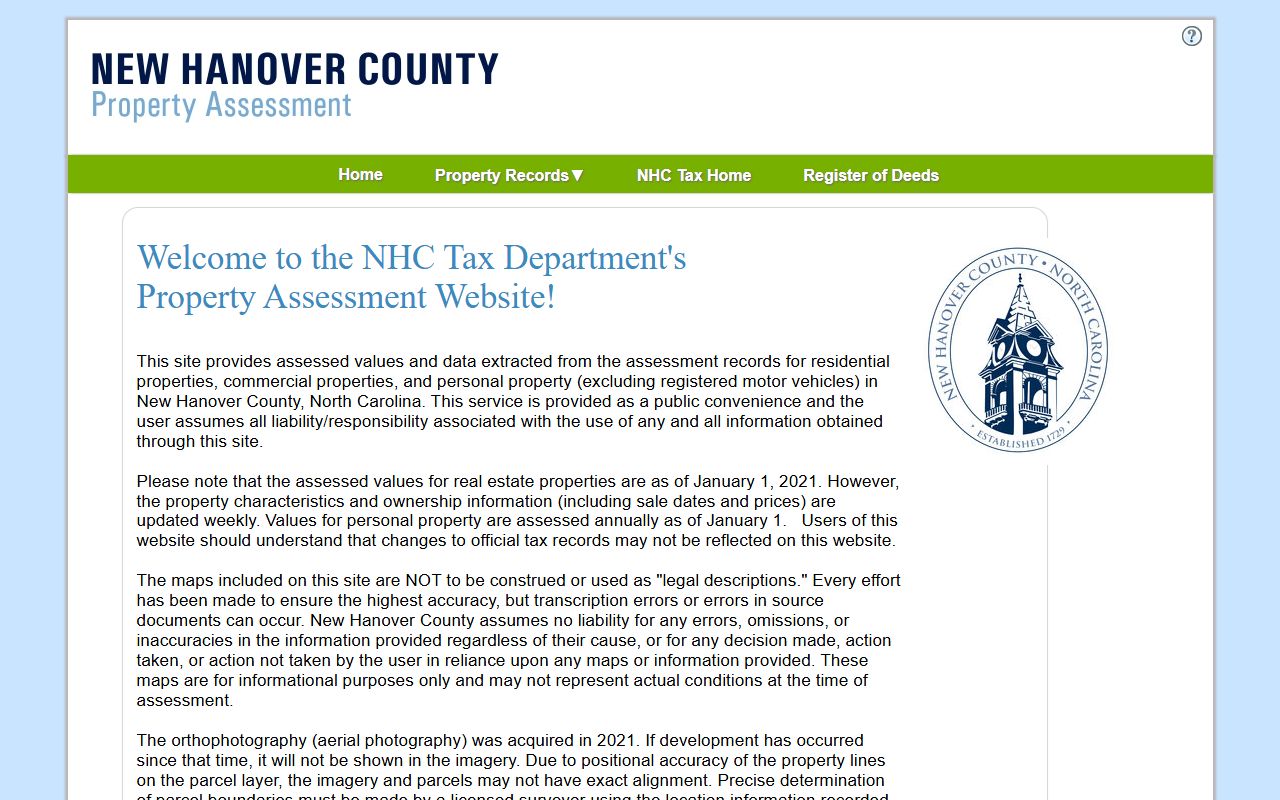
New Hanover County property tax records are managed by the Tax Administration office in Wilmington, North Carolina. Wilmington serves as the county seat. The office is at 230 Government Center Drive, Suite 190. Property owners can search assessed values for residential, commercial, and personal property. New Hanover County updates real estate records weekly and assesses personal property annually as of January 1. These records are available online and at the office during business hours, Monday through Friday from 8:00 AM to 5:00 PM.
New Hanover County Quick Facts
New Hanover County Tax Administration
The New Hanover County Tax Administration office handles all property tax records for the county. Staff appraise and assess every taxable parcel under G.S. 105-289 and the North Carolina Machinery Act. The office processes payments, maintains assessment records, and assists property owners with questions about their bills or values.
New Hanover County uses a permanent listing system for real property. Once a parcel is on the rolls, it stays listed until ownership or use changes. Real estate values were last set as of January 1, 2021. Personal property must be listed each year by January 31. The office updates property tax records weekly to reflect new transactions, permits, and changes across New Hanover County.
| Office |
New Hanover County Tax Administration 230 Government Center Dr, Suite 190 Wilmington, NC 28403 Phone: (910) 798-7300 Email: TaxAdmin@nhcgov.com |
|---|---|
| Hours | Monday through Friday, 8:00 AM to 5:00 PM |
| Website | etax.nhcgov.com |
New Hanover County Property Values
New Hanover County has seen strong growth in property values. The median property value reached $371,800 in 2023. That was a 9.13% increase over the prior year. Homeownership in the county stands at 56.1%. These trends affect property tax records across the county.
Downtown Wilmington shows the scale of growth in New Hanover County. In 2013, downtown had 1,359 parcels valued at $609.7 million total. By 2023, that grew to 1,566 parcels with a combined value of $1.36 billion. That more than doubles the total assessed value in just ten years. This growth drives changes in New Hanover County property tax records and affects revenue for both the county and the city of Wilmington.
The county tax rate is $0.574 per $100 of assessed value. The city of Wilmington adds $0.485 per $100. Properties in unincorporated areas with fire districts pay an additional $0.070 per $100. Your total rate depends on where your property sits within New Hanover County.
Search New Hanover County Tax Records
The New Hanover County online tax portal is the fastest way to search property tax records. Enter the owner name, property address, or parcel ID. Results show assessed values, tax amounts, payment status, and parcel details.
For in-person searches, visit 230 Government Center Drive, Suite 190, in Wilmington. Staff can pull up records and print copies. Call (910) 798-7300 for phone inquiries. You can also email TaxAdmin@nhcgov.com with questions about your New Hanover County property tax records.
Note: Maps in the New Hanover County property tax records are for reference only and do not serve as legal property descriptions. For legal boundaries, contact the Register of Deeds at 320 Chestnut Street, 2nd Floor, at (910) 798-4530.
How New Hanover County Calculates Taxes
New Hanover County follows the standard North Carolina formula. Divide the assessed value by 100. Multiply by the tax rate. That produces your annual tax bill. All property is assessed at 100% of market value as of January 1.
Tax bills go out in August. Payment is due September 1. Taxes become delinquent on January 6 of the following year. Interest and penalties apply after that date. New Hanover County can pursue collection through foreclosure under G.S. 105-374 for unpaid taxes. Property owners should review their New Hanover County property tax records each year to check for errors in the assessed value or billing amount.
New Hanover County Property Tax Appeals
Property owners in New Hanover County can appeal their assessed value. The appeal window runs from January 1 through the adjournment of the Board of Equalization and Review. Start with an informal review at the Tax Administration office. Staff compare your property to similar parcels and may adjust the value.
If the informal review does not resolve your concern, appeal to the New Hanover County Board of Equalization and Review under G.S. 105-322. Present evidence such as recent sales of comparable properties or an independent appraisal. The board has authority to change assessed values. The final step is the North Carolina Property Tax Commission under G.S. 105-288. Few New Hanover County cases reach this state-level review.
Tax Relief in New Hanover County
New Hanover County offers several relief programs for qualifying property owners. Applications are due June 1 each year on Form AV-9.
The Elderly or Disabled Exclusion under G.S. 105-277.1 helps homeowners age 65 and older or those with total disability. The Circuit Breaker under G.S. 105-277.1B caps taxes based on income for qualifying elderly or disabled New Hanover County residents. Disabled veterans receive a $45,000 exclusion on their assessed value. Farmland and forestland may qualify for Present-Use Value assessment under G.S. 105-277.2, which taxes land at its agricultural value rather than market value.
The Tax Administration office in Wilmington processes all relief applications. Staff can help you determine which programs apply and walk you through the forms. Your New Hanover County property tax records update once the exclusion or deferral is approved. Contact the office at (910) 798-7300 for questions about eligibility or deadlines.
Cities in New Hanover County
New Hanover County includes Wilmington and several smaller municipalities. Each city sets its own municipal tax rate in addition to the county rate. All property tax records are managed by the New Hanover County Tax Administration office.
Nearby Counties
These counties border New Hanover County. Tax rates and assessment methods vary. Check your property location to confirm which county handles your property tax records.